
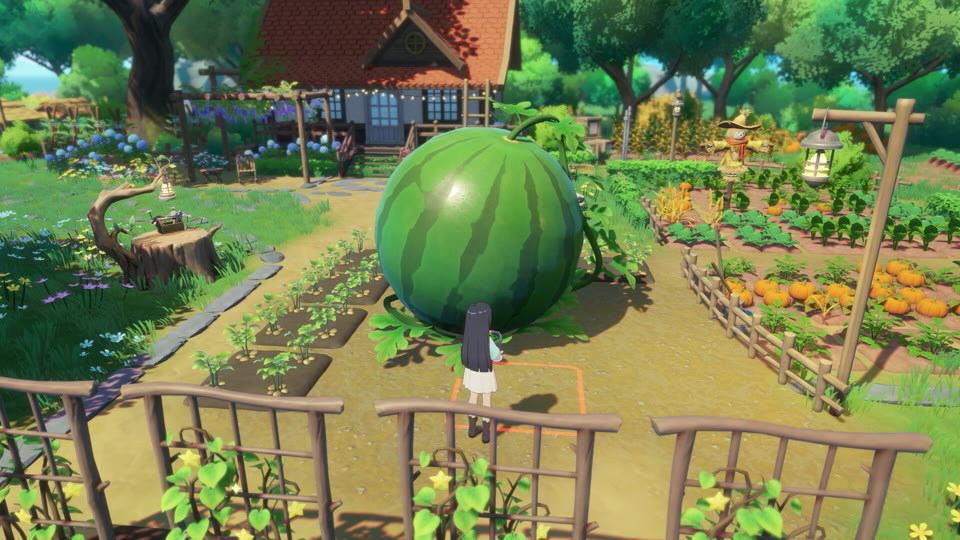

Keep fields small until watering improves, calculate the last safe planting day, and reserve 3×3 blocks for seasonal giant-crop candidates.
Farming uses three plot systems: ordinary farmland, trellises, and paddy fields. A crop that is not watered—or is blocked by the relevant pest—stops progressing.
Match the crop to the correct plot
Farmland handles ordinary crops and fruit trees, trellises must be placed before tilling, and paddy fields unlock later with the Powered Hoe.
- Rabbits remove weeds from farmland.
- Chickens remove insects from trellises.
- Ducks remove snails from paddy fields.
Plan around the 28-day season
The save starts in summer and every main season lasts 28 days. Trees remain planted but only fruit in their associated season.
- Last safe planting day = 28 minus the rounded-up growth duration in days.
- Keep a seed reserve before selling a crop’s final harvest.
- Separate normal seasonal rules from the Expert Evergrowth perk in calculators.
Use 3×3 blocks for giant crops
The seasonal candidates are Pineapple in spring, Watermelon in summer, Pumpkin in autumn, and Winter Melon in winter.
- Keep all nine tiles planted with the same candidate crop.
- Leave a walkway around each block for harvesting and pest removal.
- Do not mix different harvest dates inside a giant-crop block.
Scale automation only when it saves a real bottleneck
Sprinklers and upgraded hoes are most valuable when watering or tilling is preventing profession trials, exploration, or relationship tasks.
- Cluster water coverage before expanding the field.
- Place helper animals close to the plot type they service.
- Store upgrade materials before buying cosmetic farm pieces.
Treat giant crops as a probability campaign
A correct 3×3 candidate block creates an opportunity, not a guaranteed result. Plan giant crops as a campaign with several independent blocks, enough seed reserve to replant, and sufficient season remaining for recovery. Keep all nine tiles synchronized, watered, and free of the plot's stopping condition. Do not harvest a mature block automatically; inspect it after the game has had a normal opportunity to resolve the giant conversion in the current build. Because public guides and patches may differ on timing and chance modifiers, avoid building the whole economy around one attempt. The campaign succeeds when it produces the required giant crop without starving ordinary harvests, trials, or next season's preparation.
- Use multiple compact candidate blocks instead of one enormous field, preserving manageable watering and pest inspection while creating more independent opportunities for a successful conversion.
- Keep replacement seed and an ordinary harvest outside the campaign, so a failed giant attempt cannot consume the produce needed for requests, recipes, or seasonal continuity.
- Record planting, maturity, watering, fertilizer, and observation timing for each block; consistent notes help separate bad luck from a broken layout or missed growth day.
Stage trellises before touching the soil
Trellis farming has an important construction order: the functional trellis belongs on bare ground, so lay out the structure before tilling. Mark paths, trellis rows, bug-control coverage, and harvest access first. Then place trellises and till only the intended planting tiles. This avoids clearing and rebuilding soil when decorative and functional trellises are confused or rows become inaccessible. Since mature crops can be dense, leave sight lines that make insects visible and allow the Bug Net or chicken access to every row. A rehearsal with empty trellises is worthwhile before purchasing a full seed batch. The same design discipline matters more than squeezing one additional plant into an awkward corner.
- Place one test row on bare ground and walk both sides with the Bug Net equipped, confirming interaction and visibility before repeating the pattern across the plot.
- Differentiate functional crop trellises from decorative versions in storage and Build Mode, preventing a visual match from becoming an unusable planting layout after soil preparation.
- Keep row ends open toward storage and helper housing; closed decorative borders can force long detours precisely when a synchronized harvest creates the heaviest workload.
Plan harvest labor before planting volume
The limiting resource in a large farm may be collection and processing rather than water. Before planting, estimate how many plots will mature together, how many bag slots their variable yields may occupy, and where the crop goes next. Stagger blocks when machines cannot absorb a synchronized harvest, or synchronize them deliberately when an unlocked chain-harvest effect and ample staging storage make bulk collection efficient. Place empty crates near the exit and clear processor output before maturity. Giant candidates require their own handling because the merged crop is cut rather than picked like ordinary produce. Designing backward from harvest day prevents valuable crops from sitting on the ground or consuming the entire schedule.
- Reserve more bag and staging capacity than the minimum forecast because crop yield can vary, and a full bag causes harvested items to collect at the player's feet.
- Stagger planting by block when downstream machines are the bottleneck; synchronized visual order is not profitable if every processor remains buried under one harvest wave.
- Keep the appropriate cutting tool readily available near giant-crop blocks and preserve surrounding paths, avoiding an emergency storage or equipment trip after a successful conversion.
Diagnose a failed block with a crop log
When a crop or giant block disappoints, separate growth failure from conversion failure. For each block, record correct seed, plot type, planting time, water checks, pest checks, fertilizer, maturity time, and harvest or observation action. A crop that never matured points toward water, season, plot, or pest interruption. Nine mature matching crops that did not merge may simply reflect chance, but also verify that the block is truly contiguous and synchronized. Change one variable for the next attempt, not the entire layout. This controlled method produces useful evidence for community troubleshooting and remains valuable after patches, when an old precise guide may no longer describe the current conversion behavior.
- Photograph the completed 3×3 block from above before harvesting, capturing tile continuity and maturity so layout mistakes can be reviewed after the plants are gone.
- Use a neighboring ordinary block as a control for water and seasonal growth; if both stall, investigate their shared care conditions before blaming giant-crop mechanics.
- Include game version and platform when reporting results, since official patches can change progression or crop behavior and precise historical probabilities may no longer apply reliably.
Frequently asked questions
Can crops grow without water?
They require watering and retain water for roughly one in-game day; unwatered crops do not progress normally.
Why did a trellis crop stop growing?
Check for insects. Trellis pests stop growth until removed, just as weeds and snails affect the other plot types.