
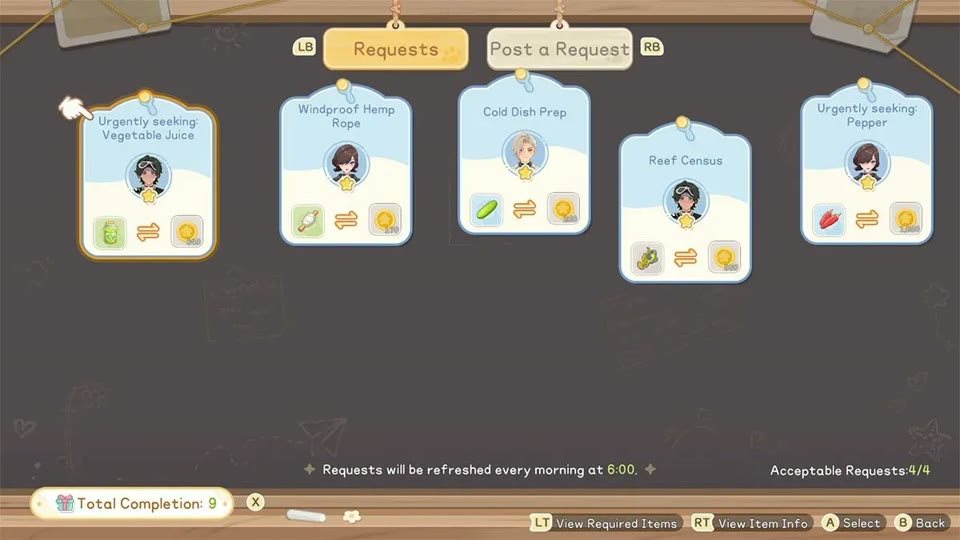

Accept jobs that use renewable surplus, overlap with today’s route, or advance a milestone. Skip requests that consume scarce upgrade, trial, or seasonal materials.
The Request Board outside the Community Center pays rewards and advances Island Life requirements. The correct request is not always the one with the largest visible payout.
Score each request on four costs
Compare item replacement, travel time, deadline risk, and what other progression the route can complete.
- Renewable surplus is cheaper than processed upgrade stock.
- A nearby delivery is better when it also reaches shops or residents.
- A seasonal item costs more near the end of its season.
Protect bottleneck inventory
A request can delay a tool or station if it consumes the exact materials reserved for the next recipe.
- Check the next profession trial.
- Check the next Worktable and land requirement.
- Keep a protected chest that is never used for routine requests.
Stack request routes
Several tasks become efficient when grouped by region and completed with relationships, shopping, or gathering.
- Accept compatible destinations.
- Carry gifts and shopping lists.
- Use the return trip for gathering or a time-window activity.
Use requests as a progression lever
Island Life counts completed requests and can increase daily acceptance capacity at later milestones.
- Prioritize request counts when they are the nearest rank gate.
- Build a Request Bulletin when Crafter progression makes home access worthwhile.
- Stop grinding once another milestone becomes the real blocker.
Run a three-question intake screen
Before accepting a board request, answer three questions in order: do I already own a safe surplus, can I obtain the item through today’s planned route, and does completion unlock or accelerate a current goal? Accept immediately when the first answer is yes and the item is not protected. Accept conditionally when the second answer is yes and the destination fits the route. Delay or reject when all three answers are no. This screen keeps attractive rewards from hiding procurement cost and prevents the board from writing the day’s schedule. The Request Board sits outside the always-open Community Center, so there is no need to treat every viewing as an emergency decision. Read the full requirement, check storage and active recipes, then commit only when fulfillment has a credible source.
- Check owned surplus first, excluding protected upgrade, trial, seasonal, breeding, and first-discovery stock at all times; only the remainder counts as immediately safe request inventory.
- Name the acquisition source and today's matching route before accepting a missing item request; if neither is known, the task is research rather than fulfillment.
- Identify the progression reason for completion—request count, relationship, reward, or route overlap—and decline weak jobs when they displace a stronger current objective today.
Build request kits without locking rare stock
Create small, renewable request kits from goods that regularly exceed household, crafting, and profession needs. Store these near the town departure point or later Request Bulletin, separated from protected inventory. The kit is not a hoard of every possible commission item; it is a rotating buffer based on requests you actually see and can replace. Review it after each season or production change. If an item stops being surplus, remove it before the next acceptance. For processed goods, include machine time in the replacement decision, not just raw material cost. A kit should let several ordinary requests be completed during existing routes while making scarce jobs visibly exceptional. This reduces last-minute harvesting and keeps the board from interrupting core production chains.
- Stock only renewable items that repeatedly remain after food, seed, crafting, trial, and sale plans, then set a modest floor that prevents the kit from consuming everything.
- Keep processed goods separate from raw substitutes, because identical input value can require very different machine queues and replacement time during a busy production season.
- Audit the kit when seasons, herd size, recipes, or profession goals change, returning any newly scarce item to protected storage before browsing the board again.
Add a mid-request rescue checkpoint
An accepted request should receive one deliberate review before its remaining window becomes stressful. At that checkpoint, compare acquired quantity, missing inputs, route availability, and the opportunity cost of continuing. If the item is nearly complete through an already planned activity, finish it. If completion now requires sacrificing upgrade stock, rare weather, or a distant standalone trip, stop escalating simply because time has already been spent. Record why the request became risky so future intake improves. The purpose of the checkpoint is not to encourage abandonment; it is to prevent sunk-cost behavior from damaging larger progression plans. Keep the required items together until hand-in and verify the board or quest state afterward, especially when several requests involve similar crops or processed materials.
- Choose the review point when at least one normal acquisition opportunity remains, leaving room to correct the plan without forcing an emergency expedition or production queue.
- Compare the remaining requirement with protected inventory and scheduled routes right now, ignoring materials already spent; only future cost should determine whether escalation is sensible.
- After delivery, confirm the request clears and rewards register before releasing reserved items or accepting another similar job whose requirements could obscure the result during verification.
Keep an acceptance postmortem
Track a small sample of completed and failed requests to learn which categories fit your island. Record item source, whether stock already existed, added travel, production interruption, and what the reward or progress accomplished. Avoid reducing the analysis to coins alone; a low-friction request may be valuable because it shares a resident route or advances an Island Life requirement. Conversely, a large visible reward can be poor if it consumes a rare seasonal input. Review patterns rather than isolated outcomes. If animal products are consistently easy while processed minerals interrupt upgrades, adjust future acceptance accordingly. As facilities, seasons, and transport improve, old conclusions may expire, so repeat the review after major progression changes instead of treating a permanent tier list as universal truth.
- Log added actions beyond the normal day—special trip, extra machine batch, protected stock withdrawal, or missed window—because these costs rarely appear on the request screen.
- Note the concrete benefit received accurately, including progression count, relationship progress, useful materials, or route overlap, rather than ranking jobs solely by their displayed payout.
- Update personal acceptance rules after new transport, automation, seasons, or production capacity changes significantly; a request category can shift from costly to convenient over time.
Frequently asked questions
Should I accept every available request?
No. Reject or delay jobs that consume scarce progression materials, have poor route overlap, or threaten a seasonal deadline.
Where is the Request Board?
It is outside the Community Center in Starsand Town; later progression can also support a craftable Request Bulletin.