
Work one category at a time, record every missing entry’s season, weather, time, region, profession, recipe, or blueprint condition, and combine compatible targets.
Islandpedia tracks discovered items and rewards, but completion is faster when missing entries are treated as condition problems rather than a single undirected collection grind.
Create a missing-entry worksheet
For each unknown item, record its category and the condition that can actually be acted on.
- Fish: season, weather, time, habitat, bait, title.
- Plants: season, plot type, seed source, growth time.
- Machines and food: blueprint or recipe source plus material chain.
Group targets by opportunity window
Weather and seasonal targets should be scheduled before always-available crafting entries.
- Make a rainy-day fish and gatherable list.
- Plant long-growth crops at the start of their season.
- Save shops and crafting for days without a rare window.
Protect first specimens
Selling or processing a new item before its entry and future uses are checked creates avoidable repetition.
- Confirm the Islandpedia entry immediately.
- Check profession trials, ponds, breeding, recipes, and requests.
- Store one reserve of scarce seasonal items.
Claim rewards and verify after patches
Completion rewards and data can change, and a previously missing counter may update after a new version.
- Clear app notifications after each category session.
- Reopen the category after obtaining an item.
- Report or recheck entries that remain missing despite verified conditions.
Prioritize the next stamp, not the emptiest category
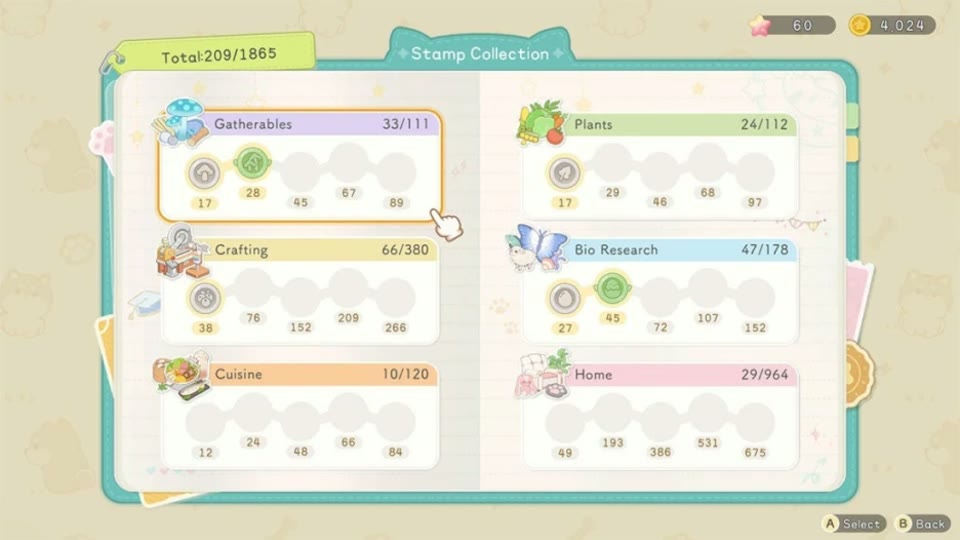
Islandpedia awards stamps at discovery milestones within its categories, so completion work should target the nearest attainable reward rather than the category with the most blank entries. Open each category and identify which one can reach its next stamp using current-season, currently unlocked activities. Then select a small batch of entries that share a production chain or travel window. This creates useful short sprints before the final all-category cleanup. Do not assume a visible blank is immediately obtainable; some entries depend on profession progression, blueprints, specialized equipment, or deeper exploration. If the next stamp requires several blocked discoveries, move to another category and return later. This approach turns the app into a progression planner and avoids spending an entire season chasing one inaccessible entry.
- Compare distance to the next stamp across Gatherables, Plants, Crafting, Bio Research, Cuisine, and Home, then choose the category with the most accessible remaining entries.
- Build each sprint around shared conditions, such as one worktable tier, one Moonlit Forest zone, or one crop season, rather than selecting unrelated blanks together.
- Mark entries blocked by a blueprint, profession rank, or specialized machine and exclude them from the active sprint until that dependency becomes genuinely available for completion.
Build dependency trees for crafted discoveries
A missing crafted item is often the end of a chain rather than a single recipe. Start from the Islandpedia entry and list its blueprint source, required worktable or machine, processed components, and the raw materials behind those components. Highlight dependencies that unlock several missing entries, such as a higher worktable, processor, or shared intermediate. Complete those nodes before crafting decorative one-offs. The Islandpedia data spans tools, equipment, crafts, food, drinks, and home objects, so a single infrastructure upgrade can affect multiple categories. Keep the dependency tree separate from ordinary shopping lists; it should show what prevents discovery, not merely what to buy. When a recipe is crafted, verify the entry and then reuse the same production setup for adjacent missing items before dismantling or reallocating it.
- For every crafted blank, record blueprint source, crafting station, intermediate parts, and raw inputs; a missing field identifies the next research task instead of another gathering run.
- Prioritize machines and worktable tiers early on that unlock several targets across categories, because shared infrastructure produces more discoveries than a single expensive decorative blueprint.
- Batch neighboring recipes while processors and materials are already staged, but preserve scarce components for entries that cannot be completed through a cheaper alternative chain.
Distinguish discovery, ownership, and verification
Completion errors often come from treating three different states as identical. An item may have been seen in a shop, owned in inventory, or successfully registered in Islandpedia. When pursuing a blank, define which action the app actually confirms and verify immediately after completing it. Keep the item until the entry appears, then move it to reserve storage if another system may need it. For processed goods, check both the input and final product rather than assuming one grants the other. For newly analyzed ore, review the result before merging stacks. If an entry stays blank, reproduce the acquisition cleanly with free bag space and no simultaneous bulk actions, then document the item, source, and version before treating it as a bug.
- Check the relevant Islandpedia page immediately after obtaining or crafting the target, while the exact action and source are still known and easy to repeat.
- Do not sell, gift, cook, or process the only copy until registration is visible and other quest, recipe, pond, breeding, or research uses have been checked.
- When verification fails, repeat one controlled acquisition with spare inventory space, capture the result, and stop grinding until the registration condition is clearly and fully understood.
Schedule cleanup by source family
Late completion becomes manageable when blanks are grouped by how they enter the game. Create source families for seasonal growing, weather or habitat gathering, shop and affection unlocks, profession trials, Moonlit Forest rewards, machine processing, and home blueprints. Assign each family a review trigger. Check seasonal lists at the start of a season, shop and relationship sources during town routes, and crafting sources after every worktable upgrade. This prevents constant scanning of the entire Islandpedia. It also exposes false grind problems: a missing cuisine entry may require a recipe source, while a missing equipment entry may require a blueprint rather than additional materials. Keep one backlog and move entries between blocked, scheduled, and verified states so no discovery disappears into informal notes.
- Tag each blank with exactly one current source family and one blocker; update the tag when new information changes the acquisition route rather than duplicating the entry.
- Review seasonal and weather-dependent families first, because missed windows are costly, while always-available crafting and shop work can safely fill ordinary days later as needed.
- After any profession rank, affection threshold, or worktable upgrade, rescan only the affected families and promote newly accessible entries into the next completion sprint immediately.
Frequently asked questions
What is the fastest category to complete first?
Choose the category already supported by your strongest profession and current season, then schedule time-limited gaps.
Why keep the first copy of a new item?
It may be needed for a trial, pond, breeding, recipe, request, or another collection system before it is easy to replace.