
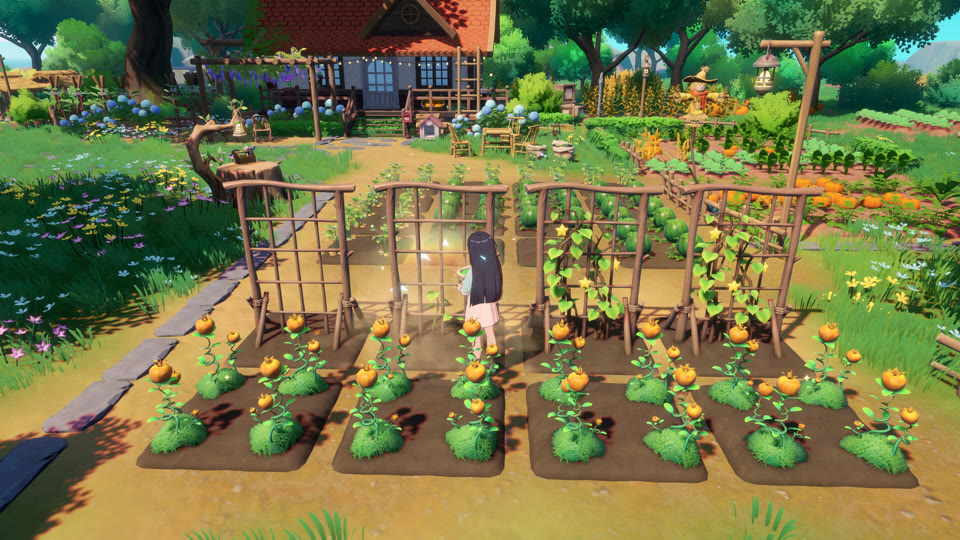

Expand when a plot unlocks the next region or when production genuinely no longer fits. Assign a role before placing permanent buildings.
Land expansion is both a currency gate and a layout decision. Buying too early drains reserves; buying without a purpose creates longer daily routes.
Use unlock requirements as the first filter
Several Island Life ranks count purchased or expanded land and connect progression toward Cloudrest Lake, Blue Beach, and later plots.
- Read the exact next milestone before buying.
- Reserve currency before reaching the rank requirement.
- Do not assume every adjacent plot has equal strategic value.
Place high-frequency work closest to home
Daily crops, animals, storage, shipping, and processors should require the shortest walk. Rarely used decoration can occupy remote space.
- Keep one compact morning-care loop.
- Place shared input storage between related machines.
- Leave straight paths wide enough for later transport.
Give each plot a job
A plot is easier to optimize when it has one dominant purpose, such as crops, livestock, industry, ponds, or decoration.
- Separate noisy production from scenic builds.
- Keep ponds and animal housing near their feed storage.
- Reserve at least one flexible zone for trial-specific buildings.
Avoid expensive rebuilds
Save layouts before moving production and test access around machines, fences, and multi-tile structures.
- Move storage last so active recipes remain understandable.
- Finish one production cluster before dismantling the next.
- Keep a temporary staging chest for materials during the rebuild.
Score plots by adjacency before purchasing
A plot's value comes from what it touches, not only its area. On the map, mark the house, main storage, shipping point, busiest processors, roads, water access, and the region used by the next project. Score each candidate plot for daily adjacency, route shortening, terrain fit, and future connection. Give the highest weight to actions performed every morning; a beautiful remote plot may be strategically weak if it adds repeated travel. Also note which boundary could connect to a later expansion, because one purchase can create a useful corridor while another becomes an isolated pocket. This qualitative score avoids pretending every save has the same optimal order and remains valid when exact land costs change.
- Walk from the house through the proposed plot at normal working speed before buying, carrying the tools you would use, to expose fences, slopes, and awkward access.
- Compare the candidate against a no-purchase alternative such as denser storage or one more processor; expansion is justified only when space or connection is truly limiting output.
- Favor plots that connect two repeated destinations when scores are close, because a through-route can save time even before the land itself is fully developed.
Reserve utility corridors before placing buildings
New land fills quickly, so draw the service network first. Reserve a main movement corridor from the entrance to storage, a secondary path between production clusters, and clear access around multi-tile machines, animal housing, fields, and water. Keep power, automation, or transport upgrades in mind even if their final footprints are not yet known; a strip of flexible ground is cheaper than relocating a finished ranch. Place permanent buildings only after walking the corridor with a full bag and imagining collection traffic at harvest. Decorative edges can absorb irregular terrain, while the center should remain adaptable. This planning turns expansion into lower daily friction rather than simply creating more places to walk.
- Use temporary markers or inexpensive floor pieces to test corridor width, then move through the route with tools equipped before committing fences and large structures.
- Keep machine inputs and outputs reachable from the main path without entering animal pens or crop blocks, reducing collisions between care, harvest, and processing routes.
- Leave at least one unassigned central service strip for later stations, robots, sprinklers, or storage; flexible capacity is a deliberate planning asset, not wasted land.
Expand with repeatable production modules
Instead of turning an entire plot into one oversized system, design a module that can be copied. A crop module includes seed storage, water coverage, helper access, paths, and harvest staging. An animal module includes feed, housing, collection, and an exit toward processors. An industry module includes raw storage, machines, finished-goods storage, and overflow space. Build one module, operate it for several days, and measure where queues or detours appear. Only then duplicate it on new land. Modular growth makes costs visible and limits the damage from a flawed layout. It also supports mixed plots without losing clarity, because every cluster still has a defined input, action, and output path.
- Test one complete module through a peak day, such as synchronized harvest or full product collection, because ordinary days may conceal access and storage failures.
- Duplicate only the parts that stayed consistently busy; an extra field without matching water, helpers, storage, and processing merely transfers the existing bottleneck somewhere else.
- Keep module boundaries visually obvious with paths or labels, allowing later relocation to happen cluster by cluster rather than dismantling an entire plot at once.
Stage a relocation rehearsal
Before moving a mature production zone, rehearse the transfer with temporary storage and one inactive day in the plan. Photograph or save the current layout, list every machine and input stack, and build the destination's paths and storage before dismantling anything. Move a low-risk cluster first and run one cycle. If items flow correctly, transfer the next cluster; if not, the old system still supports production. Keep active quest materials in a separate protected box throughout. This phased rehearsal avoids the common failure where all machines are moved at once, recipes become mixed, and the farm loses several days rebuilding. It also reveals whether the expansion truly shortens the route before irreversible decoration follows.
- Prepare destination storage with the same labels as the old zone, then transfer contents by category so recipe inputs cannot be mistaken for sale or overflow stock.
- Leave the original busiest machine operating until its replacement completes one successful cycle, preserving essential output while the unfamiliar new route is still being tested.
- Compare actual morning travel before and after the first cluster; stop the move if the new plot adds crossings or separates inputs from their main consumers.
Frequently asked questions
Should I buy land as soon as it becomes available?
Only when it advances an Island Life requirement or solves a real capacity problem without emptying your progression reserve.
What should stay closest to the house?
Anything used daily: crop care, animal care, shipping, common storage, and the busiest processors.