
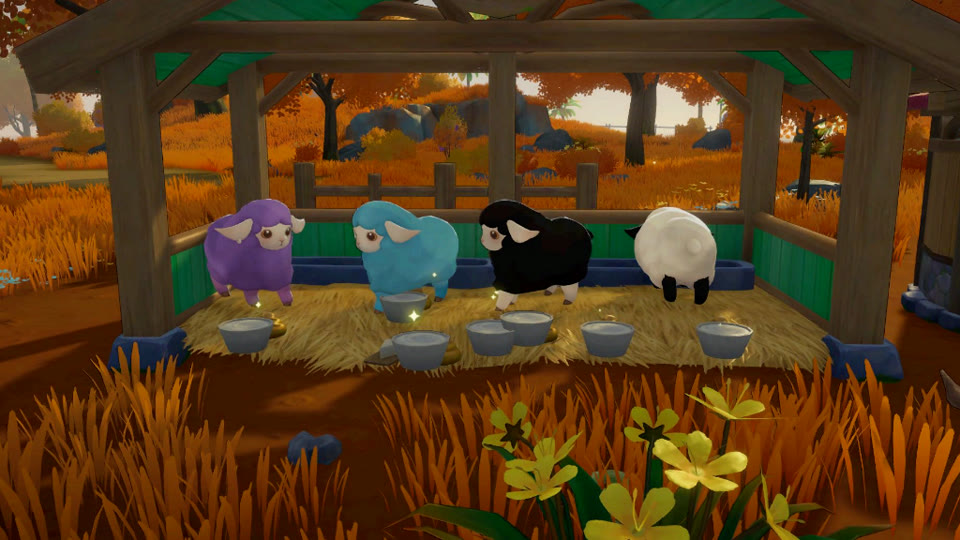

Stabilize daily care first, then breed toward one goal at a time: product output, helper work, temperament, or a specific trial requirement.
Breeding works best as a controlled improvement project. Adding animals faster than feed, housing, care, and storage can support lowers the value of the whole ranch.
Create a care reserve before expansion
A ranch needs several days of feed, clean accessible housing, and storage for products.
- Prepare feed before buying or breeding.
- Leave space around troughs and collection points.
- Keep one emergency reserve separate from daily stock.
Protect happiness and hygiene
Care quality affects the reliability of the product and breeding loop.
- Feed and collect products before a long expedition.
- Avoid crowding paths and interaction points.
- Fix repeated care failures before adding another species.
Breed toward one measurable trait goal
A focused breeding plan is easier to evaluate than keeping every offspring.
- Decide whether the goal is yield, helper capacity, rarity, or a quest.
- Record parent traits before starting.
- Keep the best replacement and sell only after confirming the next pairing.
Scale processing with the herd
More products only create profit when machines, recipes, storage, and shipping can absorb them.
- Compare daily output with processing capacity.
- Protect trial and relationship items.
- Add machines only where a queue remains full across several days.
Create a permanent breeder record
Selective breeding becomes manageable when every candidate has a record beyond appearance. Assign each animal a short identifier and note species, sex, visible variant, useful traits, product behavior, helper role, and observed care reliability. Photograph the trait screen before pairing. Track offspring under both parents so promising lines can be repeated and weak outcomes do not lead to accidental inbreeding of identical goals. Public data can describe possible variants and traits, but your record should govern decisions in the current save. This is especially important when a rare-looking animal has ordinary work value, or a common-looking animal carries the trait that best supports pest control, product output, or temperament.
- Use one row per animal and update it after adulthood or a newly observed product, avoiding conclusions based solely on juvenile appearance or a single care day.
- Keep labeled screenshots of both parents and the offspring together, creating durable evidence for future pairings when names, housing, or herd size make memory unreliable.
- Mark the animal's intended role as breeder, helper, producer, mount, or collection specimen; clear role definitions prevent every rare variant from occupying limited breeding capacity.
Run breeding in small evaluated batches
Breed toward one target in batches small enough that housing, feed, and evaluation remain stable. Before pairing, define the desired outcome and the maximum number of offspring the current ranch can support. Keep open housing capacity and separate nursery space if the layout allows. Evaluate the entire batch at the same maturity stage, retain the best candidate for the next generation, and pause before starting again. Continuous uncontrolled breeding hides which pairing produced improvement and can crowd access to troughs or collection points. A batch method also protects happiness: routine care remains predictable while the population changes. Expansion resumes only after feed reserves and product processing absorb the new baseline.
- Write the target before pairing, such as stronger helper capacity or a specific variant, then reject unrelated novelty from changing the plan midway through the batch.
- Set a housing ceiling below the absolute maximum so unexpected offspring do not block paths, exceed feed preparation, or force rushed sale decisions before evaluation.
- Pause breeding after each batch and compare traits, products, and daily care time; the best successor is the one that improves the intended role without destabilizing the ranch.
Use explicit keep, retire, and sell rules
Herd decisions are easier when rules are written before attractive offspring appear. Keep an animal if it improves the active breeding target, protects genetic or variant diversity needed later, or fills a productive role the ranch can support. Retire a breeder when a successor clearly improves the target and the older animal has no unique role. Sell only after confirming that the next pairing, Islandpedia discovery, profession requirement, and product reserve are safe. These rules prevent sentimental overcrowding without reducing animals to sale value. They also create a stopping point: once a line meets its practical objective, redirect breeding space to another species or keep the stable herd instead of chasing endless marginal variation.
- Compare candidates within the same intended role; a superior mount and a superior farm helper answer different needs and should not compete on one vague ranking.
- Protect one proven backup breeder until the chosen successor reaches adulthood and performs as expected, avoiding loss of the line after an incorrect juvenile assessment.
- Release sale stock only after recording it and checking unique variants or traits, since an irreversible decision should not depend on appearance or crowded storage alone.
Audit welfare through operational signals
Happiness is not only a meter to maximize; it is a signal that the ranch layout and daily routine are working. Track missed feed, blocked interactions, dirty or inaccessible areas, uncollected products, and care tasks skipped before expeditions. If premium or special outputs require high happiness, treat inconsistent production as a reason to inspect care before expanding breeding. Music, petting, housing, and feed systems should fit one short route with clear access. Run the audit after every population increase or relocation. When failures repeat, reduce breeding activity, restore reserves, and fix the physical path first. A smaller consistently cared-for herd provides better evidence for trait and product comparisons than a crowded unstable one.
- Record missed care events beside product observations, separating a possible trait effect from lower output caused by feed, access, or happiness disruption during the same period.
- Walk the full care route during peak occupancy and remove any obstacles around troughs, housing, and collection points before adding automation or another breeding pair.
- Maintain an emergency feed reserve outside daily stock and pause breeding when it is used, treating reserve depletion as evidence that the current herd exceeds reliable support.
Frequently asked questions
When should I start selective breeding?
After feed, housing, care, and product storage are stable enough that extra animals will not break the daily loop.
Should I keep every rare-looking offspring?
Check traits and your breeding goal first; appearance alone may not solve the productivity or helper target.