
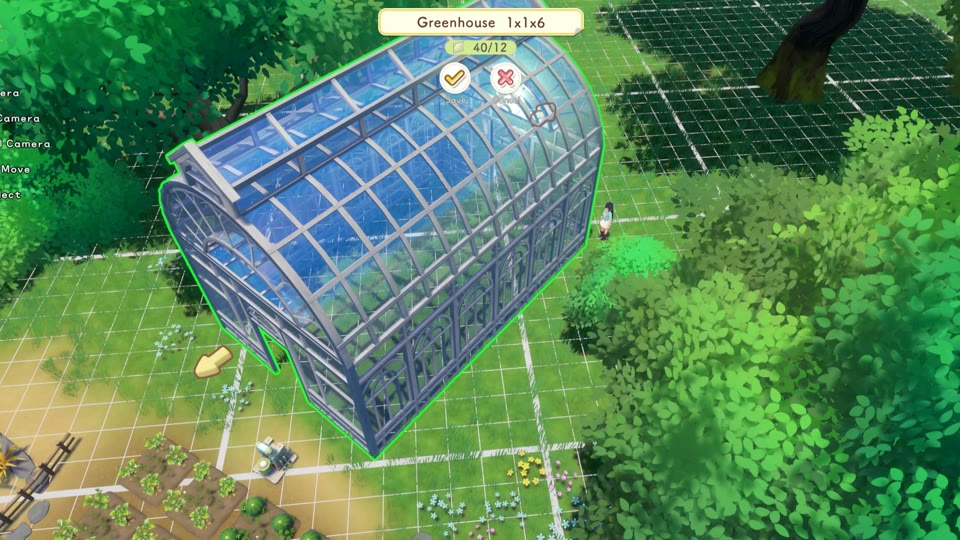

Reserve season-free capacity for rare ingredients, regrowing crops, trial stock, and dependable processing inputs. Keep ordinary seasonal bulk outside.
Late farming can reduce seasonal limits through advanced facilities and the Expert Evergrowth skill. The value comes from protecting hard-to-replace crops, not merely planting more tiles.
Choose crops by replacement difficulty
A greenhouse slot should solve scarcity or continuity.
- Prioritize crops needed across several recipes or requests.
- Keep at least one route for seed renewal.
- Use regrowing crops when their repeated yield supports a permanent machine chain.
Do not ignore labor capacity
Season-free crops still create watering, pest, harvest, and storage work unless later systems remove it.
- Expand only after irrigation or stamina can support it.
- Leave paths for helpers and harvesting.
- Avoid synchronized harvests that overflow processors.
Separate greenhouse and Evergrowth assumptions
Calculators and guides should distinguish normal seasonal rules from the Expert skill that lets crops grow in any season.
- Confirm that Evergrowth is active before planting outside normal seasons.
- Keep a conventional plan for saves below Expert Farmer.
- Recheck skill behavior after balance patches.
Build a year-round ingredient pipeline
Connect protected crops to the smallest set of profitable or useful recipes you can process consistently.
- Match weekly crop output to machine capacity.
- Store emergency ingredients for trials and festivals.
- Sell surplus only after seed, recipe, and request reserves are met.
Assign protected space to four crop roles
Divide greenhouse or otherwise protected capacity into continuity, scarcity, breeding, and reserve roles. Continuity crops feed machines or recipes that should run year-round. Scarcity crops are difficult to replace outside a short season. Breeding or seed-renewal plots preserve the chain that creates future packets. Reserve plots remain flexible for sudden trials, festivals, or balance changes. A crop can serve more than one role, but write its primary job so harvest is not sold by accident. Rebalance the allocation each season rather than filling every tile permanently. This portfolio approach protects access to ingredients while avoiding the common outcome where profitable bulk crops occupy all protected space and leave no room for progression-critical planting.
- Give every protected block a destination label such as grinder, kitchen, trial reserve, or seed renewal; unlabeled output tends to drift into general storage and sale.
- Keep a portion of tiles deliberately uncommitted until the season's requests and certification needs are known, treating flexibility as productive capacity rather than unused space.
- Review replacement difficulty after unlocking new seed sources or Evergrowth tiers, because a crop that once required greenhouse protection may later be cheaper outside it.
Set planting quotas from machine demand
Work backward from the consuming recipe instead of filling protected space with the highest-value seed. Observe how many crop units a machine chain uses over a normal week, subtract reliable outdoor supply, and plant only enough protected tiles to cover the remaining demand plus a modest reserve. If output continually accumulates, reduce the crop quota; if machines wait for ingredients, expand that crop before adding another recipe. Include secondary ingredients and storage limits, since one abundant crop cannot keep a complex chain running alone. Quotas align land, harvest labor, and processing throughput without depending on a fragile profit table. They also make changes easy: adjust one block when a recipe or skill shifts demand.
- Measure actual machine consumption for several complete cycles before setting the quota, carefully excluding days when travel or missing secondary ingredients caused abnormal idle time.
- Count outdoor harvest as seasonal supply rather than guaranteed weekly supply near transition dates, then let protected space cover only the continuity gap you can prove.
- Reduce planting when finished goods remain unsold or unused; building more processors does not fix a chain whose real bottleneck is demand or another ingredient.
Transition to Evergrowth in controlled phases
Evergrowth changes seasonal planning, but its tiers describe improving off-season performance rather than identical normal growth. Begin with a small test block outside the crop's season and record water, pest status, visible growth, and maturity timing. Keep core protected production unchanged until the test completes. If the slower off-season pace still meets the machine or reserve requirement, move one role outdoors and repurpose greenhouse space. Repeat after another tier or patch instead of extrapolating from the first result. This phased migration avoids committing a large field to assumptions based on old descriptions. It also recognizes that never withering and growing quickly are different benefits, each valuable for different crop roles.
- Test a familiar crop with a well-known in-season baseline, making differences in off-season progress substantially easier to observe accurately than with a newly unlocked variety.
- Move continuity crops only after the off-season block supplies a complete planned cycle; a plant surviving is not evidence that its yield matches processor demand.
- Retest after meaningful skill-tier upgrades and balance patches, recording complete build information so the planning model reflects current observed behavior rather than inherited community estimates.
Design a failure-resistant protected farm
Protected growing removes some seasonal risk, not every operational risk. Preserve separate seed stock, leave access for watering and pest response, maintain overflow storage, and avoid synchronizing all essential ingredients to one harvest moment. Keep at least one alternative source or substitute recipe for the most important chain. When expanding, simulate a missed care day or full processor queue: if the system cannot recover without consuming its seed reserve, it is too brittle. A resilient greenhouse continues to serve trials and recipes during festivals, expeditions, or layout work. Its success is measured by continuity under disruption, not by the maximum number of planted tiles during a perfectly managed week.
- Store renewal seed outside the main harvest chest and never count it as recipe inventory, preventing one bulk-crafting action from eliminating the crop's recovery path.
- Stagger essential ingredient blocks so a missed harvest or storage overflow affects only one part of the pipeline rather than every recipe input at once.
- Leave one reachable staging box and a clear central path through the protected area, enabling emergency collection even when the bag, machines, or normal schedule is unexpectedly disrupted.
Frequently asked questions
Should every high-value crop go into protected space?
No. Use the space for crops that are season-limited, hard to replace, or essential to a year-round production chain.
Does Evergrowth matter before Expert Farmer?
No. Plan around normal seasons until the skill is actually unlocked and active.