
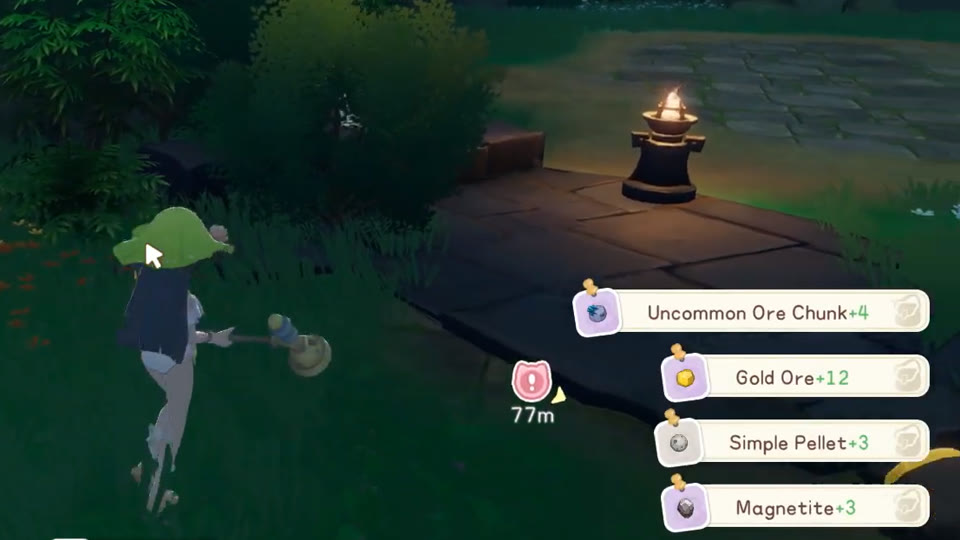

Do not run the whole forest every trip. Choose one recipe target, enter the nearest useful zone, use camps to extend the route, and leave when food, ammunition, or bag space hits its reserve limit.
Moonlit Forest contains progression materials from Copper, Tin, Fluorite, Quartz, Coal, Iron, Salt, and Gold through advanced ores such as Primorite, Magnetite, Oilstone, Flamecore, Diamond, Aurorite, and Moonstone.
Early route: secure industrial basics
Copper, Tin, Quartz, Fluorite, Coal, Iron, and Salt support tools, worktables, glass, alloys, and common machines.
- Prioritize the resource blocking the next station.
- Mine safe nodes before spending ammunition on optional fights.
- Return with complete recipe batches rather than mixed fragments.
Mid route: prepare advanced processing
Gold and higher-tier ores become valuable when Worktable II, Gear Smith, upgraded tools, and specialized machines enter the plan.
- Carry the tool tier required by the target node.
- Reserve rare ore before experimenting with decoration.
- Use camps to cook, craft, or sleep instead of abandoning the route.
Late route: enter with a material budget
Primorite, Magnetite, Oilstone, Flamecore, Diamond, Aurorite, and Moonstone feed expensive late systems.
- Write down the exact quantity before departure.
- Bring health food and multiple ammunition types.
- Keep an empty bag section for rare drops and treasure.
End every run with processing
A mining trip is unfinished until ore is sorted, reserved, and placed into the correct processing queue.
- Load the slowest furnace or analyzer first.
- Store the next recipe batch separately.
- Update route notes when a tool or station changes the bottleneck.
Route from the finished component backward
Begin with the machine, tool, or blueprint you want to complete, then trace every processed component back to raw ore. This prevents a route from overproducing the obvious metal while missing coal, quartz, salt, or another supporting input. Write the full component chain beside the mining list and check existing storage before leaving. If one ingredient comes from a safer region, collect it separately rather than stretching the forest route across unrelated zones. The Moonlit Forest resource map distinguishes basic, intermediate, and deeper materials, so a single circuit is rarely the most efficient answer. Backward planning also clarifies whether the real bottleneck is mining at all: a full furnace queue, missing Ore Analyzer, or unavailable blueprint may make another ore trip premature.
- Translate the final recipe into raw inputs and subtract stored materials before choosing a forest zone; the remaining deficit, not the recipe headline, defines the route.
- Include processing support in the list, especially fuels or secondary minerals, so mined ore does not sit idle while a less glamorous ingredient blocks completion.
- Cancel the trip when the required blueprint, worktable, analyzer, or processor is still unavailable; unlock the conversion step before accumulating another unsorted stockpile without delay.
Separate direct ore from analyzer inventory
Moonlit Forest gathering can produce named ore as well as Common and Rare Ore Chunks intended for the Ore Analyzer. Keep these streams separate from the moment they enter the bag. Direct ore can be assigned immediately to a known recipe, while chunks represent uncertain future output and should not be counted toward a guaranteed batch. At home, give the analyzer its own input chest and a destination for every result. Run a sample before committing all chunks when storage is tight, then update the mining plan using confirmed outputs. This avoids promising an upgrade from unopened chunks and prevents analyzer results from being scattered among general crafting boxes. It also makes Islandpedia checks easier, because newly revealed materials remain visible as a distinct processing batch.
- Do not include unopened chunks in a recipe count; list them as potential supply until the Ore Analyzer converts them into named materials you can actually allocate.
- Place analyzer input and output storage beside the machine, with empty space ready for unfamiliar results rather than forcing new materials into an already mixed mineral chest.
- After each analysis batch, reserve first discoveries, assign known materials to recipes, and revise the next route only from the remaining confirmed deficit with confidence.
Build paired outbound and return lines
A productive ore route should not require retracing every branch while carrying a full bag. Design an outbound line that reaches the highest-priority nodes quickly and a return line that gathers common supporting materials near the exit or camp. The outbound pass protects stamina and ammunition for the scarce target; the return pass uses whatever capacity remains without jeopardizing the mission. Place optional nodes into three groups: always collect, collect only with spare capacity, and ignore. Reclassify them when a new tool, recipe, or processor changes demand. If the deep target is absent or inaccessible, switch to a predefined fallback cluster rather than wandering between zones. A paired route turns uncertainty into a controlled decision and makes the exit path increasingly valuable instead of repetitive.
- Put scarce or progression-blocking ore early in the route, while health, bag space, and concentration are strongest; leave abundant support materials for the safer return leg.
- Assign every optional node a capacity rule before departure, such as collect only when the protected rare-item slots and food reserve remain untouched at all times.
- Choose one fallback cluster near a known exit or camp, so a failed deep run still returns a useful batch without creating another long combat loop.
Measure route quality by usable batches
Raw item count is a poor measure of a mining route. Evaluate each trip by how many complete crafting or processing batches it enables and how much unresolved material it leaves behind. A route that yields fewer total objects can be better if its ores enter the furnace immediately and finish a tool tier. Keep a small route log with target, zone, supplies spent, confirmed outputs, and the next blocked component. Compare only trips with the same objective; otherwise a safe copper circuit and a deep Moonstone attempt are not meaningful competitors. When a route repeatedly returns fragments of many recipes, narrow it. When processing queues wait empty, broaden the return leg to include the missing support ore. The goal is continuous production, not maximal collection statistics.
- Record completed recipe batches and leftover fragments separately in storage; fragments reveal where mixed routing is accumulating inventory without advancing the intended construction or upgrade.
- Note whether the furnace, analyzer, or other processor started immediately after unloading, because idle machines often expose a missing secondary input that route totals conceal.
- Retire a route once its target stock is healthy, and redirect effort to the next blocked component instead of repeating a familiar circuit out of habit.
Frequently asked questions
What should decide my mining route?
The next recipe or profession gate, followed by tool access, camp position, combat risk, and remaining bag space.
Should I collect every node I pass?
Only while capacity allows. Preserve space and stamina for the target material and rare drops.