
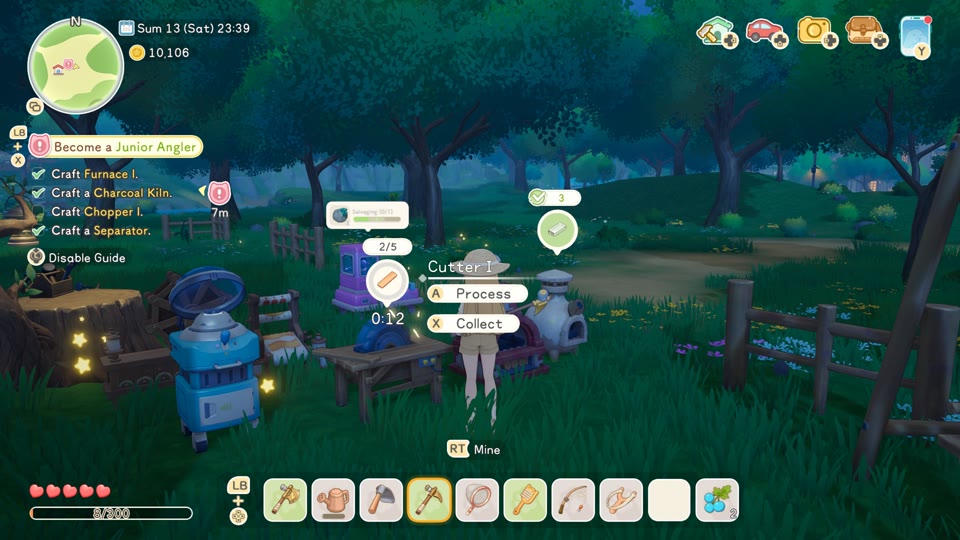

Group each chain into an input box, processor, and output box. Duplicate only the processor that stays full while downstream machines wait.
Production speed is limited by the slowest recurring stage, not by the total number of machines. Good layout makes that stage visible and easy to refill.
Map the chain from goal to raw material
Start with the desired tool, station, meal, or building and list every intermediate in reverse.
- Include planks, ingots, sheets, wire, glass, fabric, and food intermediates.
- Mark which machine creates each step.
- Protect quest items that share the same input.
Create compact production cells
Each cell should contain raw input, the relevant machine, and completed-output storage within a few steps.
- Separate ore, wood, textile, food, and ammunition cells.
- Put shared materials between two cells only when both use them often.
- Leave expansion space beside the likely bottleneck machine.
Duplicate from queue evidence
A machine deserves a duplicate when it remains occupied across several work cycles and starves the next stage.
- Observe the queue for several days.
- Do not duplicate a processor waiting for scarce inputs.
- Increase output storage before increasing throughput.
Load overnight and review in the morning
Long processes should run while the player sleeps or travels, with tomorrow’s inputs ready nearby.
- Load the slowest stage before bed.
- Keep one batch of the next input prepared.
- Collect output before starting the morning regional route.
Set queue caps with visible input and output lanes
A machine should advertise its state without opening several interfaces. Place a small input lane on one side and a completed-output lane on the other, then assign each a working cap. The input cap represents the next scheduled batches, while the output cap is the point where collection or downstream processing must happen. Do not fill either lane simply because space exists. When input is empty, the shortage is upstream; when output is full, the next stage or demand is blocked; when both are full, the machine may be unnecessary at that moment. These visible signals create a lightweight queue board in the world. They also make morning and evening rounds faster because the next action is readable from storage state rather than memory.
- Size the input lane for the batches you can realistically process before the next collection round, keeping unrelated raw materials in their own local storage.
- Treat a full output lane as a stop signal: collect, consume, or deliberately archive the product before loading more of the same recipe, then update the queue board.
- Place a written target or distinctive marker beside temporary project queues so surplus production ends when the intended tool, building, or trial is complete, then update the queue board.
Arbitrate shared inputs before loading machines
Several production lines may consume the same ore, wood, crop, fish, or intermediate. Loading machines first and deciding priorities later makes the fastest refill habit control the economy. Instead, divide shared inputs during a brief planning pass. Reserve the quantity required by mandatory recipes, allocate a measured batch to routine production, and leave an emergency floor untouched. Only then move materials into machine-side boxes. If two chains are equally important, alternate complete batches rather than splitting stock so thinly that neither finishes. This is especially useful when food, bait, tools, ammunition, and building components overlap. The rule keeps machine uptime from becoming the only success metric; a busy processor is not productive when it consumes the input needed to unlock a more valuable system.
- Before the evening load, review tomorrow's quest, expedition, and profession needs, then reserve their shared ingredients outside the routine machine input lane, then record the allocation decision.
- Choose complete batches that deliver a usable outcome, such as one upgrade packet or one fishing session, instead of distributing scarce stock evenly across unfinished queues.
- When priorities change, empty only unstarted input lanes and preserve work already processing; constant mid-batch switching creates clutter without recovering meaningful resources, then record the allocation decision.
Schedule queues by the player's absence window
Queue length should match when you can next service the machine. Use short processes while working nearby, medium batches during town errands, and the longest reliable batches before sleep or a distant expedition. The exact recipe time matters less than aligning completion with a natural return point. A machine that finishes immediately after you leave may remain idle all day, while an oversized batch can lock a shared ingredient through a changing priority. Build three standard absence windows from your actual routine and prepare batch cards for each. When weather or a rare fishing condition changes the day, select the appropriate card rather than improvising. This approach increases useful uptime while preserving flexibility for new quests, drops, and profession unlocks.
- Observe how long your home loop, town loop, and full regional expedition usually take, then match recipes to those practical service intervals, then revise the service schedule.
- Keep one ready batch for each absence window beside the machine, but do not preload tomorrow's materials if a certification or blueprint purchase is imminent.
- On returning, collect before refilling and inspect downstream capacity first; automatic repetition is wasteful when completed outputs already exceed the next stage's demand, then revise the service schedule.
Build fault isolation into multi-tier production
Complex chains fail quietly when similar machines, component tiers, and storage boxes are packed together. Give every chain a checkpoint after each irreversible conversion and keep one clearly labeled sample of the expected output near the next stage. If production stops, inspect checkpoints from the final product backward until the first missing component appears. This isolates whether the problem is raw supply, the wrong machine tier, a forgotten blueprint, a full output box, or material diverted elsewhere. Leave enough walking space to inspect and collect from each station independently. For expensive late chains, run a single test unit before loading the full reserve. Fault isolation costs a little space but prevents a mistaken recipe or misplaced component from tying up an entire progression batch.
- Label machines by tier and purpose, especially when earlier and later versions look similar or retain overlapping recipes that make a wrong selection seem plausible.
- Trace a stalled goal backward from final worktable to the earliest empty checkpoint, checking output capacity and blueprint availability before gathering more raw material, then update the fault log.
- Process one test unit whenever a new component chain is unlocked, then verify its next use in the recipe interface before committing rare inputs to a full batch.
Frequently asked questions
How many copies of each machine should I build?
One until repeated observation shows that a full queue is blocking downstream work.
What is the simplest useful layout?
A three-part cell: labeled input storage, the processor, and labeled output storage.